Materials and Energy
Catalysis and Chemical Processing
Generate novel catalyst compositions, support configurations, and active-site geometries optimized for selectivity, activity, and durability.
The Challenge
Why Catalysis and Chemical Processing needs a new approach to generation
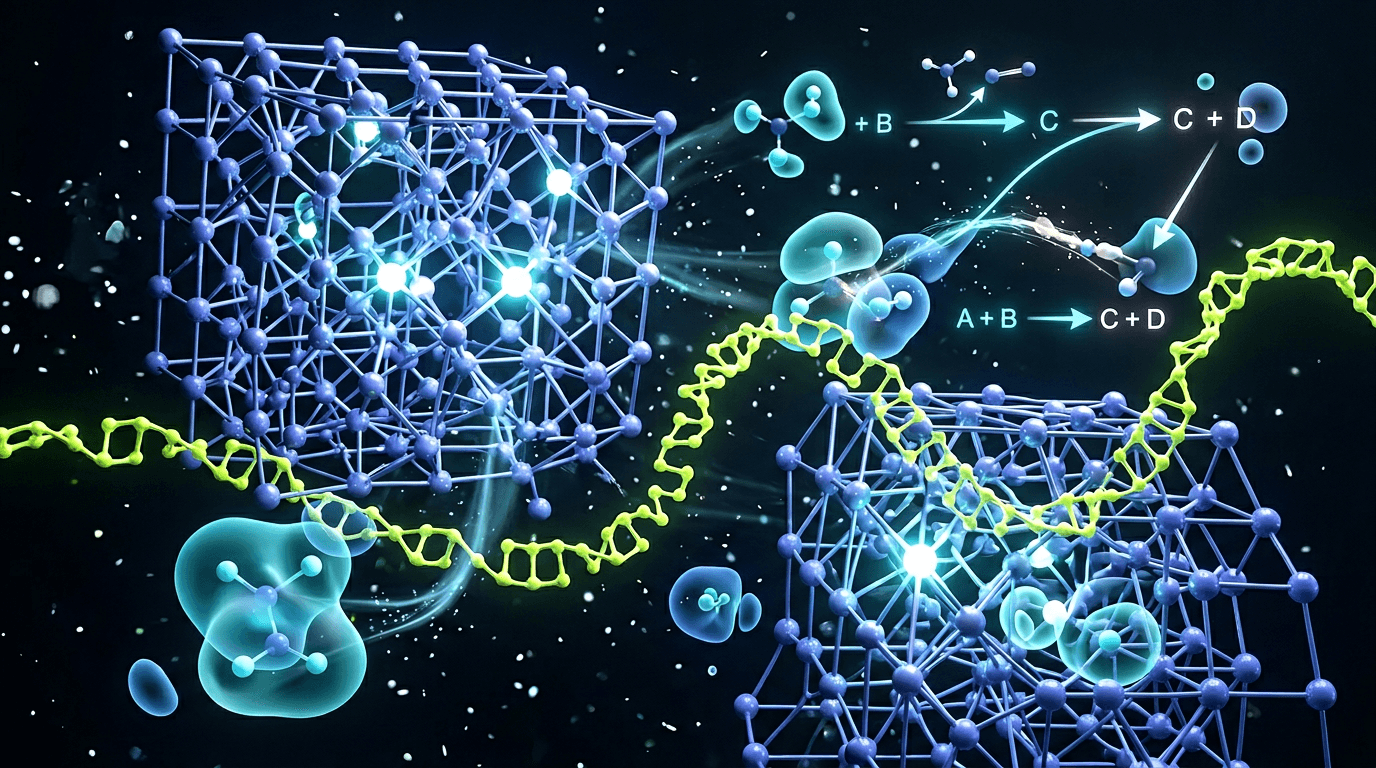
Catalyst design is one of the most consequential materials challenges in the chemical industry — catalysts underpin over 80% of industrial chemical processes, yet discovering new catalytic materials remains dominated by trial-and-error synthesis campaigns and incremental modification of known formulations. The space of possible catalyst compositions, support interactions, promoter combinations, and nanostructure geometries is combinatorially vast. A single heterogeneous catalyst system involves choices across active metal, oxidation state, support material, particle morphology, promoter elements, and preparation method, creating a design space that empirical exploration can only sample sparsely. High-performing catalysts for emerging applications — CO₂ reduction, green hydrogen, biomass conversion — remain undiscovered because the search space dwarfs available experimental throughput.
Current catalyst generation methods rely on computational screening using density functional theory to evaluate adsorption energies on pre-defined surface facets, descriptor-based models that correlate activity with a small number of electronic properties, or combinatorial library synthesis covering narrow composition ranges. DFT screening evaluates only the candidates researchers think to propose and is limited to idealized surface models that may not represent real operating conditions. Descriptor models like d-band center correlations work within known catalyst families but fail when applied to novel multi-metallic or single-atom systems where the underlying scaling relations break down. None of these approaches truly generate — they filter from a human-curated search space.
The MatterSpace Approach
How MatterSpace generates for catalysis and chemical processing
MatterSpace Lattice generates catalyst candidates by navigating the joint space of composition, structure, and active-site geometry under user-defined performance constraints. Specify the target reaction, desired selectivity above a threshold, operating temperature range, and forbidden elements, and Lattice constructs novel catalyst architectures that satisfy all constraints simultaneously. The generation process respects surface thermodynamics, metal-support interaction physics, and stability under reaction conditions — producing candidates where the active-site geometry, electronic structure, and support environment are co-optimized rather than treated as independent variables.
The catalysis pipeline uses the Chemical Processing domain pack encoding adsorption thermodynamics, surface reaction mechanisms, and catalyst deactivation physics. The constraint interface accepts reaction-specific inputs: target conversion, selectivity requirements, space velocity, deactivation tolerance, and cost limits on constituent elements. Lattice generates candidate catalyst systems — specifying composition, crystal phase, particle size distribution, and support material — with predicted activity, selectivity, and stability metrics. Each candidate is validated against thermodynamic stability under reaction conditions and known poisoning mechanisms before output, and ranked by a configurable objective that balances activity, selectivity, lifetime, and material cost.
Constraint-Based Generation
Specify what the output must satisfy. MatterSpace constructs candidates that meet all constraints simultaneously.
Valid by Construction
Every output satisfies physical laws, stability criteria, and domain constraints — no post-hoc filtering needed.
MatterSpace Lattice
Powered by a domain-specific generation engine with physics-aware priors and adaptive dynamics control.
Generation Output
What MatterSpace generates
- Novel catalyst compositions with predicted activity and selectivity
- Active-site geometries with electronic structure profiles
- Multi-metallic formulations with support specifications
- Catalyst-support interaction architectures
- Stability-optimized candidates with deactivation resistance scores
Key Differentiators
Why MatterSpace is different
MatterSpace Lattice co-generates catalyst composition and structure simultaneously, producing candidates where active-site geometry, electronic environment, and support interactions are jointly optimized — unlike sequential approaches that optimize composition first and structure second. The system generates candidates outside the scaling relation boundaries that constrain descriptor-based design, accessing novel catalytic motifs that linear free-energy relationships cannot predict. Every candidate includes predicted stability under operating conditions, addressing the persistent gap between computed activity and real-world durability. Support for multi-objective generation produces catalyst candidate sets that balance the competing demands of activity, selectivity, stability, and cost that define industrial viability.
Same sector
Related industries
Battery Cathodes and Energy Storage
Generate novel cathode compositions and crystal structures optimized for energy density, cycle life, and thermal stability.
ViewSuperconductors and Quantum Materials
Generate novel superconducting material candidates with predicted critical temperatures, targeting accessible operating conditions.
ViewPhotovoltaics and Solar Energy
Generate novel photovoltaic absorber compositions and heterostructure designs optimized for efficiency, stability, and manufacturability.
ViewThermoelectrics and Waste Heat Recovery
Generate novel thermoelectric material compositions with optimized figures of merit for efficient waste heat conversion.
ViewHigh-Entropy Alloys
Generate novel high-entropy alloy compositions with targeted mechanical, thermal, and corrosion properties across multi-principal-element design spaces.
ViewMagnets and Magnetic Materials
Generate novel permanent magnet compositions and crystal structures targeting high energy products without critical rare-earth dependencies.
ViewCoatings and Surface Engineering
Generate novel coating compositions and multilayer architectures optimized for hardness, corrosion resistance, thermal barrier performance, and adhesion.
ViewSolid-State Electrolytes
Generate novel solid-state electrolyte compositions with high ionic conductivity, wide electrochemical stability windows, and mechanical compatibility.
ViewMetamaterials
Generate novel metamaterial unit cell geometries with target electromagnetic, acoustic, or mechanical properties through constraint-based topology construction.
ViewMetal-Organic Frameworks
Generate novel MOF structures with target porosity, gas selectivity, and catalytic activity through systematic exploration of metal node, organic linker, and topology combinations.
ViewPolymer Design
Generate novel polymer architectures with target mechanical, thermal, and barrier properties through systematic exploration of monomer chemistry, chain topology, and processing parameters.
ViewGet started
Start generating with MatterSpace
Whether you are exploring catalysis and chemical processing for the first time or scaling an existing research programme, MatterSpace generates novel candidates that satisfy your constraints by construction.
Contact us